How One EdTech Startup Booked 14 District Demos From 1,200 Contacts (Not 50,000)
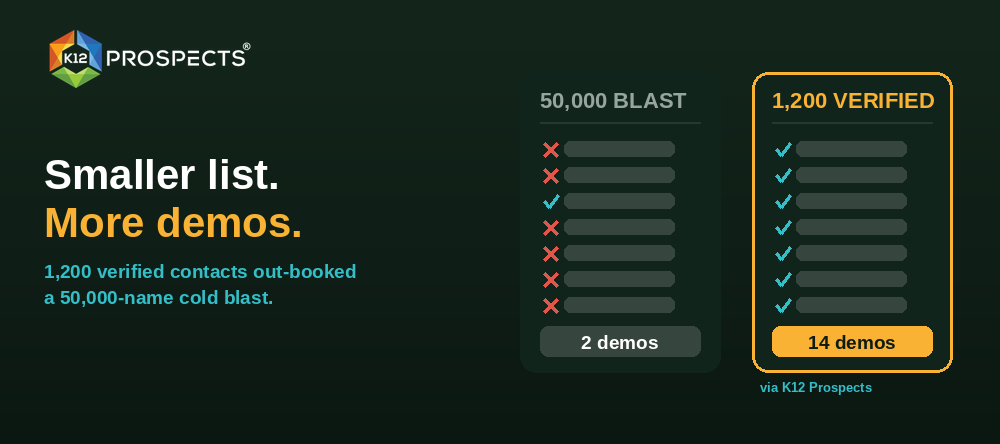
A startup sent the same offer two ways. Once to a 50,000-row purchased list, and once to 1,200 verified, role-matched district contacts. The blast booked two demos and singed the sending domain. The targeted send booked fourteen.
(The company below is a composite, drawn from patterns we see across K-12 vendors. The numbers are representative of what a stale mega-list and a clean targeted list actually produce, not one client’s private data.)
For a company selling into school districts, the instinct is almost always more. More contacts, more sends, more pipeline. The experiment that follows shows why that instinct quietly works against you, and what a smaller, accurate list does instead.
The two-list experiment
Brightpath Learning, a small literacy-intervention vendor, had budget for one real push before the fall buying season. The team split the effort down the middle. Half went to a 50,000-contact list bought cheap from a generic data broker. The other half went to 1,200 contacts pulled from K12 Prospects, a verified, role-segmented K-12 source, filtered to curriculum directors and assistant superintendents in districts that matched the product.
The offer was identical both ways: a free pilot of the literacy program plus a one-page results summary from a comparable district. Same sender, same week, same product. The only variable was the list.
What the blast actually cost
On the surface, the 50,000-name send looked like the smart bet. The numbers tell a different story:
- Hard bounces ran about 18 percent of the stale purchased list, roughly 9,000 dead addresses on the very first send.
- Inbox placement collapsed: after spam-trap hits and complaints, only about 55 percent of the survivors reached an actual inbox.
- Opens landed near 5 percent of delivered mail, about 1,400 opens spread across tens of thousands of names.
- Demos booked: two.
The damage didn’t stop at two demos. The spike of bounces and spam-trap hits dropped the domain’s sender reputation, so the next three campaigns Brightpath sent, to good contacts, landed in spam far more often. Cleaning that up and keeping a district list clean took weeks of careful sending the team hadn’t budgeted for.
On paper the blast was cheap. The list ran about $0.02 per contact, a thousand dollars for fifty thousand names. Two demos puts the real price near $500 per booked meeting, before counting the reputation repair that produced no pipeline at all.
Why 1,200 contacts beat 50,000
The targeted send ran the same week and quietly outperformed on every line that mattered:
- Hard bounces came in around 2 percent, just 24 addresses, because the contacts were verified and current.
- Inbox placement held near 95 percent, since the clean send kept the domain in good standing.
- Opens reached about 35 percent of delivered mail, close to 400 opens from only 1,200 names.
- Demos booked: fourteen.
Here is the part that surprises people: the verified list was not even more expensive. At about $0.017 per contact from K12 Prospects, the 1,200 names cost roughly $20, slightly less per contact than the broker’s blast. Fourteen demos puts the price near $1.50 per booked meeting, against $500 from the blast. Same offer, same week, same product. The list was the whole difference.
Relevance did the heavy lifting. Because every contact carried a known role, Brightpath wrote to a curriculum director about reading outcomes and to an assistant superintendent about budget fit, instead of flattening one message for everyone. Writing differently for a superintendent than for a curriculum director is its own skill, and a role-tagged list is what makes it possible at all.
The role-matched email that did the work
Here is the note that went to curriculum directors, lightly edited:
Subject: A reading-intervention pilot a few nearby districts asked about
Hi [First name],
Westbrook USD ran our literacy intervention with their lowest-quartile readers last year and moved 38 percent of them up a band by spring. I pulled a one-page summary of how they did it.
If it’s useful, I can send the summary and, if you want, set up 20 minutes to see whether it fits [District]. No pressure either way.
Compare that with the version that went to all 50,000:
Subject: FREE Literacy Solution for Your School!!
Dear Educator, our award-winning platform boosts reading scores district-wide. Click here to book a demo today!
The first reads like a person who knows the district. The second reads like a filter test, and Microsoft and Google now treat it that way.
The hidden tax most vendors never see
The two-demo result is the visible cost of the blast. The invisible cost is what it did to every send that came after. Mailbox providers score a domain on its sending history, and a single spike of bounces and spam-trap hits pulls that score down for weeks. Brightpath’s next newsletter, sent to engaged district contacts who had opened before, watched its inbox placement slide from the mid-nineties into the seventies. Nothing about that audience had changed. The domain had.
List decay makes the problem sharper in K-12 than in most markets. District staff turn over heavily every summer, so a list bought in March is measurably weaker by August. A curriculum director who left in June is now a hard bounce, and a few thousand of those across a big purchased list is all it takes to cross the threshold providers watch. The 1,200-contact list sidestepped this because it was verified close to send time and refreshed as roles changed.
The math is unforgiving. A list decaying at even 2 percent a month loses roughly a quarter of its deliverable addresses over a year. On 50,000 names that is about 12,000 dead contacts quietly accumulating, each one a small deposit against your sender reputation. On a maintained 1,200-contact list, the same decay rate is a couple dozen addresses you can replace before they ever bounce. The big list doesn’t just underperform once; it degrades a little more with every month you hold it.
The setup you can copy
Three moves separated the targeted send from the blast, and none of them require a bigger budget:
- Start from accurate, role-segmented contacts. A verified K-12 list keeps your bounce rate low, which protects the sender reputation every future campaign depends on. K12 Prospects exists for exactly this: current, role-tagged district and school contacts you can actually reach.
- Read the public buying signals, then act with the right contact. A new curriculum director, a posted RFP, a fresh grant award, or a board vote shows up in board minutes and local news, not in a database filter. Spot the signal in the open, then use an accurate contact to reach the person it points to.
- Follow up in sequence, not in bursts. The fourteen demos didn’t come from one email; they came from a short, patient series sent to people who were actually reachable.
The lesson is not that small lists are magic. It is that a clean, current, role-matched list lets every other thing you do, your copy, your timing, your follow-up, actually reach a human. A list that updates as districts change staff keeps that advantage from decaying between campaigns, which is where most vendors quietly lose it.