
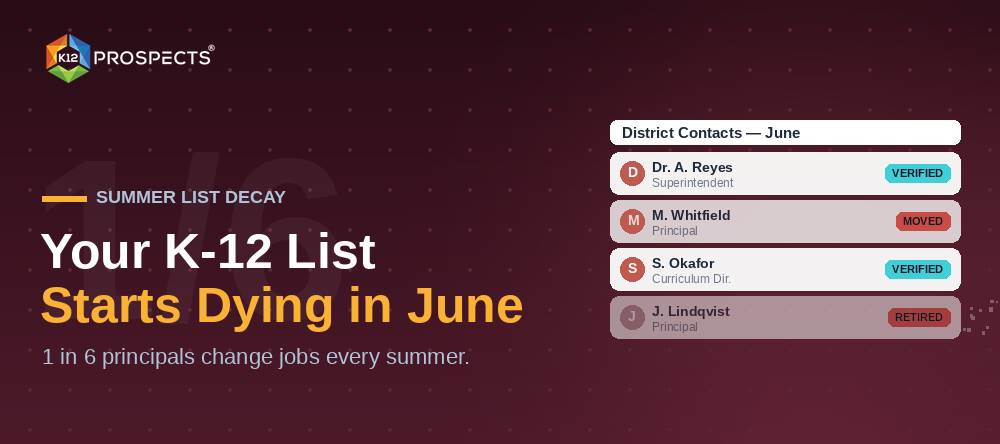
Your K-12 List Starts Dying in June: A Summer Re-Verification Plan
How companies that sell to schools can stop summer staff turnover from wrecking their fall email campaigns.
Roughly one in six of the principals on your contact list this June won’t hold the same job by September. Some retire, some move districts, some step up to central office — and nearly all of those moves happen inside a single eight-week window, because administrator contracts end June 30 and new assignments begin July 1. Your list doesn’t decay evenly across the year. It collapses in the summer, all at once, and it does so quietly.
For a company that sells to schools, the timing could not be worse. The list you’ll use for the most important campaigns of your year — back-to-school — is at its least accurate exactly when you need it most. This article lays out the plan: what to pull from your spring bounce data, why mid-July is when list updates start mattering, why you need to keep updating through October as assignments keep shifting, what to do with vacant seats, and how to turn the new hires who just inherited the budgets you sell into an advantage instead of a bounce.
Why K-12 Contact Data Decays in Summer
National studies put annual principal turnover at roughly 16 percent, and superintendent turnover has run higher than that in recent years. Assistant superintendents, curriculum coordinators, and technology directors follow the same rhythm, because nearly everyone in district leadership works on a contract that expires June 30. Resignations and retirements are announced in spring, boards approve replacements through early summer, and the new org chart takes effect July 1. The result is that 70 to 80 percent of a year’s contact churn lands in about eight weeks.
The decay is faster than most vendors assume because district IT departments deactivate email accounts quickly — often within two to four weeks of a departure, sometimes the same day. There is no graceful forwarding period the way there often is in the corporate world. And summer is also when districts merge, rebrand, or migrate email domains, which can invalidate addresses for people who never changed jobs at all.
Example. A curriculum director in a 9,000-student Texas district accepts a deputy superintendent role two counties away, effective July 1. Her old district deactivates her mailbox on July 15. Her new district publishes her in its staff directory on July 20. A vendor who verified its list in May has a dead record; a vendor who updates in mid-July finds both the vacancy and her new seat — two opportunities instead of one bounce.
The Real Cost: A September Bounce Spike
Run the arithmetic on an ordinary list. Say you hold 20,000 K-12 contacts and 16 percent of them churn over the summer — that’s 3,200 stale records. If even half of those hard-bounce on your first big September send, you’re posting an 8 percent bounce rate. Mailbox providers start treating senders as careless somewhere above 2 percent, and the major platforms now enforce their standards with permanent rejections rather than polite throttling.
The damage compounds because the send that bounces is the same send that establishes your fall reputation. A bounce-heavy first week of September means slower delivery and more spam-foldering through October — applied to the 16,800 contacts on your list who are still perfectly good. District-side security gateways keep their own scores too, and they remember. The real cost of a stale list isn’t the wasted sends to departed people; it’s the deliverability penalty those sends impose on everyone who stayed.
Start With the Bounce Data You Already Have
Before spending a dollar on list updates, mine your May and June campaign reports. Bounce codes classify themselves into three buckets, and each calls for a different action:
- 550 5.1.1 — user unknown. The person is gone or the address changed. Suppress these immediately and flag the district for a replacement lookup; the seat still exists even though the person left.
- 550 5.7.x — blocked by policy. This is not decay. The contact is probably still valid and a filter refused your mail. Deleting these records throws away good contacts to fix a deliverability problem that deletion won’t fix.
- 421 / 452 — deferred or mailbox full. Common in dormant summer inboxes. Don’t purge on a summer soft bounce; retry these in September before deciding anything.
Sorting your spring bounces this way usually reclassifies a surprising share of what looked like list rot. Suppose your June send produced 600 bounces: a typical split is about 350 genuine user-unknowns, 150 policy blocks you need to fix on the sending side, and 100 soft bounces that will resolve themselves when staff return in August. Treating all 600 as dead contacts would overstate your decay by nearly half — and mask a filtering problem that deletion can’t solve.
Update Your List From Mid-July Through October — Not Once
Timing is the whole trick. Update your list in early June and you catch the system mid-churn: departing administrators still have live mailboxes, so their records look fine and then die in July. By mid-July the picture starts to settle — old accounts are deactivated, boards have approved the first wave of hires, and district staff directories begin reflecting the new year. That makes mid-July the starting line for refreshing your list with updated K12 Prospects data, with superintendents, principals, and anyone holding budget authority refreshed first.
But one update isn’t enough, because the churn doesn’t stop in July. School boards keep approving hires through August, late resignations trigger second-round searches in September, and central-office reassignments ripple into October as districts settle their final org charts. A list updated once in July is already drifting by Labor Day. The vendors whose fall campaigns land are the ones who refresh on a rhythm — mid-July, August, September, and a final pass in October — so every send goes out against the district as it exists that month, not as it existed at the start of summer.
Each refresh is also the moment to capture the segment you’ll be glad you have all fall: everyone who is new in their seat this year. That segment grows with every monthly update as late hires post, and it’s the highest-response audience you will mail before the holidays.
Vacant Seats and New Hires Are Opportunities, Not Errors
When a named contact leaves and no replacement is posted, resist the urge to delete the row. The seat persists even when the person doesn’t, and a vacancy in July is a purchase decision waiting to be made in September. Keep the district and role, blank the person, and route any interim outreach to a role-based address or to the next contact down in the same department — an assistant principal or department chair who can tell you who’s coming.
The new hires deserve their own campaign entirely. A principal in her first 90 days reads more vendor mail than a ten-year incumbent, because she is actively assembling her own toolkit and signaling change. The outreach that works leads with orientation help rather than product: a first-touch that offers something useful to someone new in the role — a budget-calendar reference, a transition checklist — outperforms a pitch, and it earns the right to send the pitch in October.
Example first touch to a new principal: “Congratulations on the new role at Jefferson Elementary. Most new principals tell us the hardest part of the first quarter is learning which of last year’s purchases are actually worth renewing — this one-page renewal checklist is the tool we share for that. No call needed; it’s just useful.”
The Mid-July-to-October Update Calendar
Here is the rhythm that keeps your list matched to a district roster that keeps changing all fall:
- Mid-July: First list update with K12 Prospects. The post-July-1 picture has settled enough to be worth capturing — old accounts are gone, the first wave of new hires is posted.
- Mid-August: Second update before you lock your back-to-school send list. Boards approved hires all summer; this pass catches them and grows your new-in-seat segment.
- Mid-September: Third update after your first fall sends. Late resignations and second-round searches are resolving now; fold the changes in before you scale volume.
- Mid-October: Final update as districts settle their org charts for the year. This is the list you’ll ride through the winter buying season.
- First September send: Open with your most-engaged segment to establish reputation, then scale to the freshly updated full list.
None of this is glamorous work, and that’s exactly why it’s an edge: most of your competitors will mail their June list in September and spend October wondering why nothing is landing. The list is the campaign. Districts keep changing from mid-July all the way to October, and the vendors who update with K12 Prospects on that rhythm are the ones whose mail reaches the administrators who control next year’s budgets — before a competitor does.