The August Sprint: A Three-Touch Back-to-School Campaign for K-12 Vendors
By the time students walk back through the doors in mid-August, most of the decisions that shape a district’s year are already made. Budgets were set in spring, pilots chosen in early summer, and the weeks between the Fourth of July and the first bell are when curriculum directors and IT leads quietly lock in the tools they will actually use. A vendor who shows up in September is pitching into a closed door. The August sprint is a tight, three-touch email campaign built to land in that narrow, high-intent window — and it works precisely because it is short.
The Window Is Narrow — and Earlier Than You Think
The calendar is deceptive. For the 2026-27 year the single biggest return week is around August 10, when more than a third of students are back, which tempts vendors to time their push for early August. But the decisions land earlier. Districts prefer to have new tools in place before the year is fully underway, because introducing anything mid-stream means disruption, and the largest group of K-12 officials report spending six to eleven months moving from “we have a need” to “we signed.” The practical target for a back-to-school sprint is therefore mid-July through the first days of August — ahead of the bell, while attention and budget are both still available.
Picture a mid-sized district that piloted a math intervention in the spring. The teacher feedback is in, the budget line survives, and the decision to expand it district-wide is being finalized in July by a curriculum director who will be underwater the moment staff return. A vendor with a complementary assessment tool has a three-week window to be useful to that person before the decision hardens. Reach them in July and you are part of the plan; reach them in September and you are asking them to reopen something they already closed.
This is the same counterintuitive truth behind why summer outreach outperforms fall: the quiet months are when district leaders actually plan, uninterrupted by the chaos of an active building. The vendors who win the fall are the ones already on the shortlist by August, and the shortlist is written in July.
Step Zero: Verify Before You Sprint
A three-touch sprint aimed at dead addresses is just three bounces in a row, and summer is the worst possible time for stale data. Roughly 70 to 80 percent of a year’s contact churn — retirements, promotions, reorganizations, role changes — lands in about eight weeks over the summer, which means the curriculum director you emailed in May may not be there in July. Before the first touch goes out, the list has to be re-verified against who is actually in the seat now.
That is not a nice-to-have; it is the difference between a sprint and a wasted week. Cleaning and updating the data before a campaign is what protects the open rate and keeps a sender reputation intact through a high-volume send. A verified, current K-12 list — the kind K12 Prospects re-verifies heading into each season — is what makes the three touches land on real people instead of former ones.
The Three Touches
Three is the whole design. It is enough to be noticed and remembered, and few enough to respect a decision-maker’s compressed summer calendar. Each touch has one job.
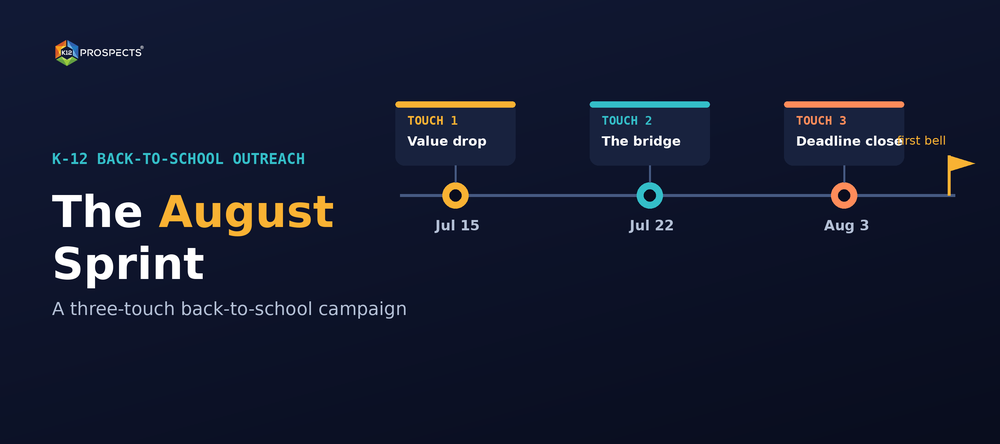
Touch 1 — The Value Drop (mid-July). A short, plain-text email that asks for nothing. It delivers one useful thing tied to the reader’s role: a benchmark, a one-line insight, a checklist, a relevant number from a district like theirs. The purpose is simply to land in the inbox and establish that you understand their world. No meeting request, no deck — just relevance and a real signature.
The value drop is the hardest of the three to write, because the temptation is to sneak in an ask. Resist it. A good touch-one gives the reader something they could forward to a colleague and look smart for sharing: a single benchmark from districts their size, a one-line finding about a change they are facing this year, a short checklist tied to their exact role. It proves you understand their world before you ask for a minute of it, and it earns the open on the next touch by making the first one genuinely useful.
Touch 2 — The Bridge (five to seven days later). This email references the first, then connects that insight to a specific outcome for their district and makes a single soft ask: a fifteen-minute call, or a one-pager if that is easier. It is the message that turns “this vendor gets it” into “maybe worth a look before the year starts.”
A bridge email earns its reply by being concrete. Instead of “we’d love to show you our platform,” it says “the reporting gap I mentioned is the thing most districts your size scramble to close in the first month — here is the fifteen-minute version of how three of them solved it.” It names a specific pain, ties it to a specific window, and makes the ask small enough to feel like a favor rather than a commitment. One outcome, one link, one calendar reference.
Touch 3 — The Deadline-Aware Close (first days of August). This one names the calendar out loud — “before students are back” — and makes one clean, easy decision: yes now, or a specific time in September. Acknowledging the window honestly does more than another feature ever could, because the reader is living that deadline whether or not you mention it.
If none of the three land, the contact does not disappear — they move into the longer nurture that carries the relationship past the sprint. The three touches are the opening of a story, not the whole of it, and they hand off cleanly to the 5-email sequence that turns K-12 lookers into buyers once the rush of the first weeks passes.
Volume, Warmup, and Not Torching Your Domain
A seasonal sprint concentrates a lot of sending into a short window, which is precisely when a cold or unwarmed domain gets flagged. If the sending address has been quiet all summer, ramp it up over the two weeks before the first touch rather than firing thousands of messages cold on a Monday in July — filters read a sudden volume spike from a dormant domain as a compromised account. Keep authentication in order (SPF, DKIM, DMARC), send in steady daily batches instead of one blast, and let engagement from the value drop build a little reputation before the higher-ask touches go out. The sprint is fast for the reader; it should not be reckless for your domain.
Timing the Sends by Role
Who you are writing to should move the send time as much as the copy. IT leaders stage systems before staff return, so they are reachable early and reward the earliest touch. Curriculum directors are buried in first-weeks logistics, so a Tuesday-through-Thursday morning — before the day’s meetings swallow them — lands best; understanding how a district curriculum director actually spends the day is what tells you which ninety-minute window your email should be sitting in the inbox for. Business officials track the budget calendar, so tie the ask to the money, not the classroom. One sprint, three send-time instincts.
Copy That Respects the Clock
Every touch in the sprint should be plain text — no images, one link, a human signature — both because it reads like a colleague and because designed HTML is exactly what district filters bury during a high-volume seasonal send. The subject lines carry the urgency without shouting it:
Touch 1 subject: a quick benchmark before Jefferson’s year starts
Touch 3 subject: 3 days before staff return — one decisionTouch 3 opening:
Hi Sam — your teachers are back next Monday, so I’ll keep this to one question. If the reporting gap we flagged is still open, we can have it closed before day one. Fifteen minutes this week, or should I follow up in mid-September?
Short, specific, and honest about the calendar. Nothing in it needs a design to work; the timing and the plain phrasing are the campaign.
Instrument the sprint before it runs so you can learn from it either way. Tag the three touches as a single campaign, watch which touch earns the reply — it is usually the second or third, which tells you the value drop did its quiet job — and note which roles and district sizes respond, because that pattern is your targeting for next season. A sprint that books three demos and teaches you who to write to in January has done two jobs, not one.
Segmentation makes the sprint sharper without making it longer. The same three-touch skeleton can carry a different opening line for curriculum, IT, and business audiences — the same email, one sentence swapped — so each reader sees a first line that speaks to their actual job. That single-sentence personalization is usually the difference between a note that gets skimmed and one that gets a reply, and it costs almost nothing once the list is segmented by role.
When the Sprint Misses
Not every district buys in August, and the sprint is not a failure when it does not close — it is a placement. Log who opened and who replied, move the non-responders into the standing nurture, and treat the sprint as the seed for a second-semester and next-budget-cycle follow-up. The window reopens; the vendors who ran a clean August sprint are the ones already recognized when it does.
August rewards vendors who move early and briefly. Three well-timed, plainly written emails to a verified list will out-book a polished September campaign every year, because they arrive while the door is still open. Build the list in June, write the three touches in July, and let the first bell find you already on the shortlist.