
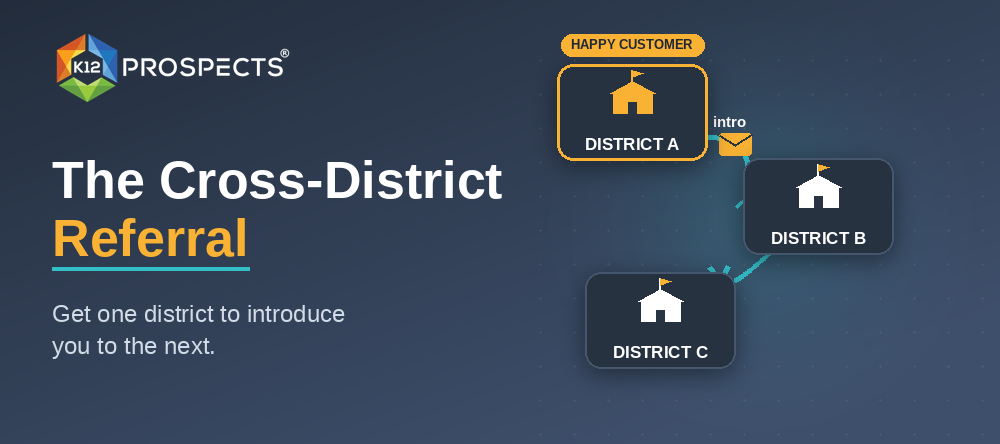
The Cross-District Referral: Getting One District to Introduce You to the Next
A superintendent's recommendation to a peer district clears the inbox that a vendor's cold email never would. Most vendors sit on a handful of happy customers and never once ask them to make the introduction.
That gap is the most expensive habit in K-12 sales. You spend months earning a district's trust — proving the product, surviving the security review, closing the deal — and then you file the win in your CRM and start the whole cold cycle over again with the district next door. That neighbor's curriculum director sits beside your customer at the same regional meeting every month. The relationship you already built is the fastest path into the account you want next, and it costs nothing but the nerve to ask.
This piece walks through how to turn a satisfied district into an introduction: how to spot a customer who is ready to vouch for you, how to make an ask that is easy to say yes to, how to route the introduction so it lands as a peer endorsement instead of a sales handoff, and how to follow through without burning the goodwill you just spent.
Why a peer introduction clears the inbox
Administrators trust other administrators far more than they will ever trust a vendor, and that trust moves through channels a cold campaign cannot reach. A district leader belongs to a regional consortium, a state association, a cohort from a leadership program, and an informal group text of peers who compare notes on everything from bus routing to reading curriculum. When one of them says “we use this and it works,” the recommendation arrives pre-vetted. The receiving administrator does not have to decide whether the vendor is credible; a person they respect already decided that for them.
Compare the two openings. A cold email says “I think we can help your district.” A forwarded introduction says “you should talk to these people — they solved the exact thing you complained about at the last meeting.” The first asks a stranger to take a risk; the second removes the risk before the conversation starts. Trust is the whole game in this market, and the same instinct that turns an internal skeptic into an advocate — the subject of From Gatekeeper to Champion — is what makes a peer endorsement land.
There is a deliverability payoff too. As district mail filters tighten, a first-time cold sender fights just to reach the inbox. An email a known administrator forwards internally, or one the recipient already expects because a peer mentioned your name, does not trip the same defenses. The warm intro is not only more persuasive; it is more likely to be seen at all.
Spotting a district ready to vouch for you
Not every happy customer is a referral source, and asking the wrong one at the wrong moment costs you credibility. Three signals tell you a district is ready.
The first is a concrete result they can name. A customer who says “the platform is fine” will give you a lukewarm intro that helps no one. A customer who says “we cut our benchmark-reporting time in half this fall” has a story, and a story is what travels between districts. Wait until you have a specific, recent win to point to.
The second is an individual advocate, not just an account. Contracts do not make referrals; people do. Look for the curriculum director who emails you unprompted, the technology coordinator who offered to be a reference, the assistant superintendent who name-checked your tool in a webinar. That person has already decided you are worth their reputation.
The third is timing. The best moment to ask is right after a visible success — a strong pilot result, a clean renewal, a positive board presentation, a support save where your team went above and beyond. Timing matters here more than most sellers admit; the same summer window that makes district outreach land, covered in The Overlooked Window, is when a fresh win is most likely to convert into an introduction. Ask while the good feeling is current, not six months later when the memory has faded.
Making an ask that is easy to say yes to
The reason most vendors never ask is that they picture a big, awkward favor. The fix is to make the request small, specific, and effortless. A district leader is busy; if saying yes means writing a thoughtful email from scratch, they will intend to do it and never will.
Do the work for them. Instead of “do you know anyone who might be interested?” — which forces the customer to think — name the district and the person:
We're hoping to help a few more districts in the region this year. I noticed Westbrook has been working on the same literacy-screening challenge your team tackled last spring. Would you be comfortable introducing me to their curriculum director, Dana? I'll send you a short blurb you can forward — you wouldn't have to write a thing.
Three things make that work. It gives a reason the customer can feel good about (helping peer districts, not hitting your quota). It names a specific person, so the customer does not have to brainstorm. And it offers to write the blurb, which removes the only real labor. Most people who like you will say yes to that.
If they hesitate, make it smaller still. Ask whether you can mention their name when you reach out, rather than asking them to send anything: “would it be alright if I told Dana you've had a good experience with us?” A name-drop with permission is weaker than a direct forward, but it is far stronger than a cold open — and an easy yes keeps the relationship warm for a bigger ask later.
Routing the introduction so it lands as an endorsement
How the introduction travels changes how it reads. The strongest version is a forward from the customer's own inbox to their peer, because it carries their name, their signature, and the quiet weight of “I took time to do this.” The blurb you write for them should sound like them, not like your marketing. Keep it to three sentences: the problem the peer district shares, what your customer's district did about it, and a plain suggestion to talk.
A blurb a curriculum director can forward without editing might read:
Dana — you mentioned you're wrestling with the same reading-intervention reporting we were buried under last year. We started using [Vendor] in the fall and it genuinely fixed it; our MTSS team actually trusts the data now. Worth a short call — I'll connect you two.
Notice what that does not do. It does not oversell, list features, or read like a case study. It sounds like one administrator doing another a small favor, which is exactly what it is. When your customer forwards that, the receiving district reads a colleague's endorsement, and you enter the account already trusted.
The weaker but still useful route is the double opt-in: your customer asks their peer whether it is alright to share their contact, then hands it to you. It respects the peer’s inbox and produces a contact who is expecting you. When you reach out, reference the connection in the first line so the context is unmistakable, and match your message to the role you are writing to — a superintendent and a curriculum director read the same email very differently, as Cold Emailing Teachers vs. Superintendents lays out.
A quick worked example
Put the pieces together. Say you closed Riverside Unified in the spring, and their MTSS lead — thrilled with the fall rollout — is exactly the advocate you want. Riverside sits in a county consortium with eight other districts. You ask for one introduction, to Westbrook, the neighbor with the same reporting headache, and your customer forwards a three-sentence blurb. Westbrook takes the call already trusting you, and midway through mentions two more districts in the consortium chasing the same fix.
One relationship, worked properly, just surfaced three warm accounts. Run the math against cold outreach: a strong cold campaign into those eight consortium districts might book one or two conversations after weeks of follow-up and a fair amount of spam-filter attrition. A single well-placed referral opened the same region in an afternoon, with none of the deliverability risk. That is the leverage sellers leave on the table every time they file a win and move on.
Following through without burning the goodwill
A referral is a loan against your customer's reputation, and how you treat the new contact reflects straight back on them. Respond fast — within a day — because a referrer who introduced you looks bad if you sit on it. Be exactly as helpful with the new district as you were with the one that vouched for you, and never make the referred contact feel sold to; they came in warm, so match that warmth.
Close the loop with the person who helped you. A one-line update — “thanks for connecting me with Dana; we're talking Thursday” — shows your customer their favor landed well. That single follow-up is what turns a one-time introduction into a standing willingness to refer. Referrers who feel appreciated refer again; referrers who feel used never do.
Keep the mechanics light. A formal referral program with incentives can work in some markets, but in K-12 it often backfires: administrators do not want to look like they are being paid to recommend a vendor to their peers. Most of the time a real relationship, a specific ask, and a sincere thank-you outperform any structured incentive.
Where your contact data does the quiet work
A referral tells you which district to approach next; it does not always hand you the right person to reach when the introduction stalls, or when you want to work the rest of that district while the warm contact is still warm. The neighboring district a customer names has a business manager, a technology director, and a superintendent you will eventually need, and a single introduction rarely covers all of them.
That is where an accurate, current contact list earns its keep. When a customer points you toward the district next door, verified role-based contacts let you reach the specific people the introduction did not name, act while the referral is fresh, and multi-thread the account instead of resting on one relationship. K12 Prospects keeps those district and role contacts verified and updated, so the moment a referral opens a door you already know who else is behind it — and you are reaching the person who currently holds the role, not the one who left last spring.
The referral is the opening. Consistent, well-worked contact data is how you turn one introduction into a foothold across an entire region.