How to Turn One School Into a Whole District
A single successful pilot is a foothold, not a finished deal. That distinction sounds obvious until you watch how most EdTech vendors actually treat a good pilot: they celebrate the renewal, drop a testimonial into the next sales deck, and then wait for word to spread on its own. Word rarely spreads on its own. A principal three buildings away who’s never heard of your product isn’t going to stumble onto your success story, and the curriculum director downtown isn’t tracking usage data from a school she doesn’t oversee. Expansion inside a district you’ve already landed is the fastest, least expensive revenue available to almost any K-12 vendor, and it still takes a plan as deliberate as the one that won the first sale.
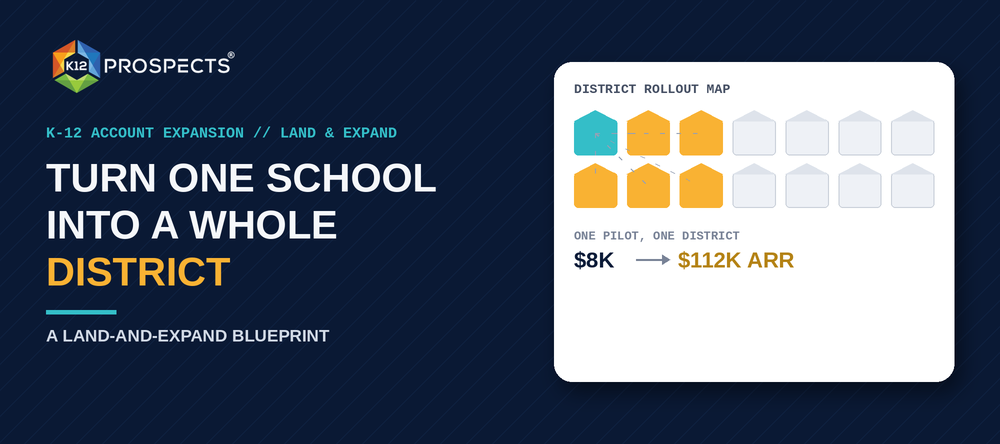
Take a literacy platform that piloted with a single elementary school inside a fourteen-school district. The pilot went well. Reading scores improved, the school’s literacy specialist became a genuine advocate, and the renewal got signed without much drama. A year later, the product was still running in exactly one school. Nobody on the vendor’s team had asked the literacy specialist a single question about the other thirteen buildings. At roughly $8,000 per school, the account that should have grown into $112,000 a year in annual recurring revenue stayed worth $8,000 — not because the product underperformed, but because nobody built a plan to make the win repeat.
Document the pilot like you’ll need to prove it to a stranger
The instinct during a pilot is to focus entirely on making the one school happy. That’s necessary, but it isn’t sufficient. From week one, the rollout should also generate three things a vendor will need months later, long after the excitement of the first sale has faded:
- Usage data broken out in a way that’s easy to compare across buildings, not buried in a single dashboard that only makes sense to the one school already using it.
- A named champion at the site level who’s willing to be the story, not just live it — someone who’ll agree to a five-minute call with a colleague at another building.
- A plain, one-sentence description of what actually changed for students or staff, specific enough that a principal could repeat it from memory at a staff meeting.
That last point matters more than it sounds like it should. “Reading scores went up 12 percent” is a statistic. “Kids who used to dread guided reading now ask for it” is a sentence a literacy specialist will actually say out loud to the principal down the hall. Vendors who collect only the statistic are leaving the more persuasive asset sitting on the table.
The expansion motion is relationship work, not a bigger pitch
Once the pilot has produced real evidence, the instinct is to go big: a polished deck, a meeting with the superintendent, a pitch for district-wide adoption in one swing. That pitch usually loses, for close to the same reason a cold email to a superintendent usually loses. It asks someone with no direct experience of the product to make a decision based entirely on someone else’s enthusiasm.
The better sequence starts smaller and moves sideways before it moves up. Identify which of the district’s other schools most resemble the successful pilot site — similar enrollment, similar demographics, a principal known to be open to new tools — and ask the original champion for a direct introduction rather than cold-approaching the new building. A genuinely enthusiastic champion will often make that connection without being asked twice, and the ask itself can be short:
“Would you be open to a fifteen-minute call with the reading specialist at Fairview? She mentioned last month that guided reading time has been a struggle at her building too, and I told her what we’ve been doing here.”
That single sentence, coming from a colleague instead of a vendor, does more work than a five-slide deck. It also means the second sale looks almost nothing like the first one: no cold outreach, no unfamiliar name landing in an inbox, no reason to start skeptical. It’s a warm handoff between two people who already trust each other, with the vendor simply showing up once the door is already open.
Repeat that pattern one or two buildings at a time, and each new site becomes its own small proof point, its own champion, and its own introduction to the next school. A district with fourteen buildings doesn’t need fourteen sales cycles run in parallel. It needs a handful of successful introductions that build their own momentum.
Time the bigger ask to the budget cycle, not to the data
There’s a natural pull to push for full district adoption the moment a semester’s worth of strong data comes in. Resist it if the timing doesn’t line up with the district’s budget calendar. A curriculum director who loves what she’s hearing from three buildings still can’t move district-wide dollars outside the window when that decision actually gets made, and a pitch that arrives at the wrong moment gets a polite “let’s revisit this in the spring” instead of a yes.
Once three or four schools are running the product with real champions in place, that’s the moment to bring the conversation to whoever actually owns a district-wide purchasing decision, typically an assistant superintendent for curriculum or a cabinet-level administrator, and it should land as a request they’ve already half-heard about rather than a cold pitch. At that point, the ask isn’t “trust us.” It’s “four of your principals are already telling each other this works, and it lines up with next year’s instructional budget.”
What derails an expansion before it starts
A few habits reliably stall this process. Pushing for the district-wide meeting the week a pilot ends, before a second or third school has ever touched the product, skips the relationship-building that makes the bigger ask credible. Leaving a champion to make introductions with nothing more than good intentions, instead of a short, specific ask like the one above, usually means the intro just never happens — people are busy, and vague requests lose to a full inbox. Cold-approaching a new principal directly, even at a school that looks like a great fit, throws away the single biggest advantage an existing win inside the district provides: a warm reference nobody else selling into that district has access to.
Expansion still depends on knowing who else to talk to
None of this works if a vendor doesn’t know who the right contact is at the fifth school, the tenth school, or in the curriculum office once the conversation moves district-wide. A champion’s introduction opens one door at a time, but an account team eventually needs its own accurate list of every relevant principal, instructional coach, and central-office contact in that district to keep several conversations moving at once without leaning entirely on one person’s goodwill. That’s a different problem than cold cross-district outreach, but it’s still a data problem: current, verified, role-specific contacts at every building in the target district, kept up to date as staff change, so an expansion conversation doesn’t stall because nobody has the right email address for the new principal who started at the eighth school in January.
Curriculum leadership in particular is worth understanding on its own terms before that district-wide conversation happens. A Day in the Life of a District Curriculum Director walks through how that role actually spends its time and when it’s realistic to expect a reply.
Reputation, not just revenue, is what actually scales
The account team’s real job shifts subtly once the second and third schools sign on. It stops being about selling a product and starts being about managing a reputation moving through a district one relationship at a time. That’s a different skill than the one that won the first pilot, and it rewards patience. A slower, relationship-driven expansion that reaches ten schools over eighteen months usually produces a more durable, harder-to-displace contract than a single fast district-wide sale ever would, because by the time the superintendent’s office signs the master agreement, the product already has a track record with real people inside real buildings, not just a testimonial from the one school that got there first.
The same discipline that turns a cold list into a first pilot still applies here, just aimed inward instead of outward. The 5-Email Sequence that turns a first district into a buyer works from the same logic: patient, well-timed, built around evidence instead of pressure. A vendor that brings that same rigor to expansion is the one that turns $8,000 into $112,000, one warm introduction at a time.