
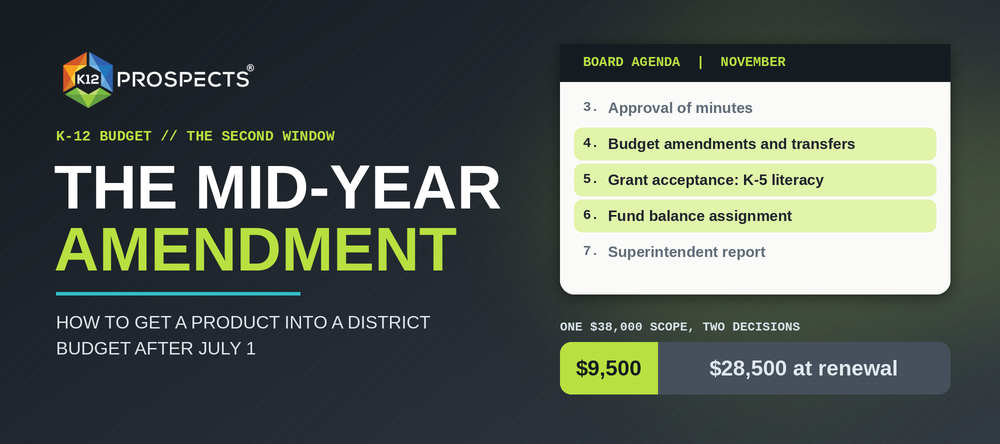
The Mid-Year Amendment: How to Get a Product Into a District Budget After July 1
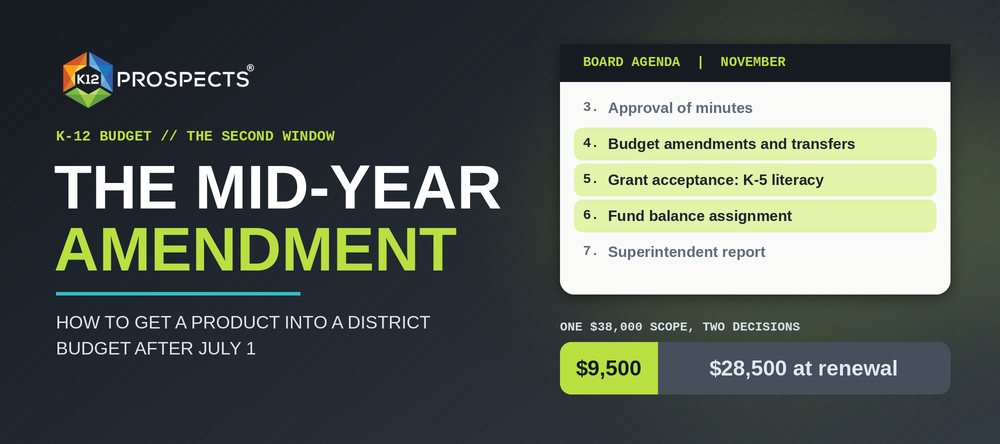
Somewhere on the November agenda of nearly every school board sits a line that reads “budget amendments” or “budget transfers.” Most K-12 vendors never read it. The vendors who do are looking at the one door that stays open after the budget is approved.
When a director says “our budget is already set,” the sentence is true for the original July 1 plan. It is rarely true for the whole year. Enrollment counts become final in the fall, grant awards arrive after adoption, and carryover from last year gets assigned to something. This article gives you a four-step sequence, a calendar, worked math, and three emails for getting a product funded in that second window.
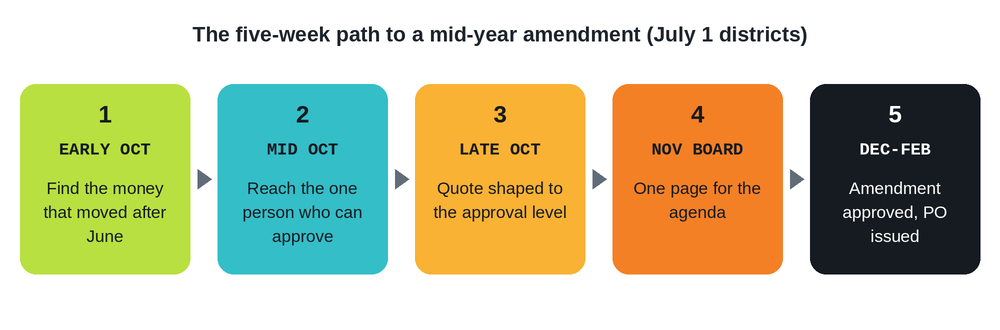
Figure 1. The five-week path to a mid-year amendment for a district on a July 1 fiscal year.
Why “the budget is set” is a sorting problem, not a no
A district budget is a forecast written in the spring. Four things change it afterward:
- Final enrollment. Fall counts replace the spring estimate, and state funding or staffing follows the real number. Districts that grow or shrink adjust budgets in the fall.
- Grants and allocations. Federal, state, and private awards often arrive after adoption and need a spending plan.
- Carryover and fund balance. Money left from the prior year is assigned during the first months of the new year.
- Vendor changes. A product that was replaced, cut, or not renewed leaves a funded line that someone has to reassign.
None of these four is a database filter, and none needs insider access. They show up in public board packets, monthly financial reports, and meeting minutes. Your job is to read them and act on what they say.
Step 1: Find the money that moved after June
Open the last two board packets for each target district. On the agenda, look for items titled budget amendment, budget transfer, grant acceptance, or fund balance assignment. In the finance report, look for lines with money assigned to a category but not yet attached to a vendor. Three minutes per district is enough to sort your list into two piles: districts with visible movement, and districts without.
Keep the first pile to 25 districts at a time. Twenty-five is enough to produce meetings and small enough to personalize every email.
Step 2: Reach the one person who can approve it
Amendments come from someone with a need and an owner of the line. That is often a curriculum director, a program director, a technology director, or a principal, and the business official reviews it. Start with the person who owns the need, since an amendment request that comes from them is a request the business office can approve. For a curriculum buyer, the Day in the Life of a District Curriculum Director article lays out when that person is reachable, and Cracking the K-12 Code covers the role map for everyone else.
Also read the district’s public purchasing policy. It tells you three things you need before you write a quote: the dollar level where a department head can approve alone, the level where quotes or a bid are required, and the level where board approval is mandatory. These levels vary by state and by district, so read the actual policy.
Step 3: Shape the quote to the approval level, with real phases
Many districts allow a director to approve a purchase up to a set amount without a board vote, with higher amounts needing quotes, a bid, or board action. A product priced above that line should be offered in phases only when a phased start reflects how the district would actually use it. A first phase of two schools, one grade band, or one term is real scope. Slicing a single purchase into pieces to avoid bidding or board rules is not allowed in many places, and it ends relationships. Confirm with the district’s purchasing office that a phased agreement is acceptable and put the full scope in writing.
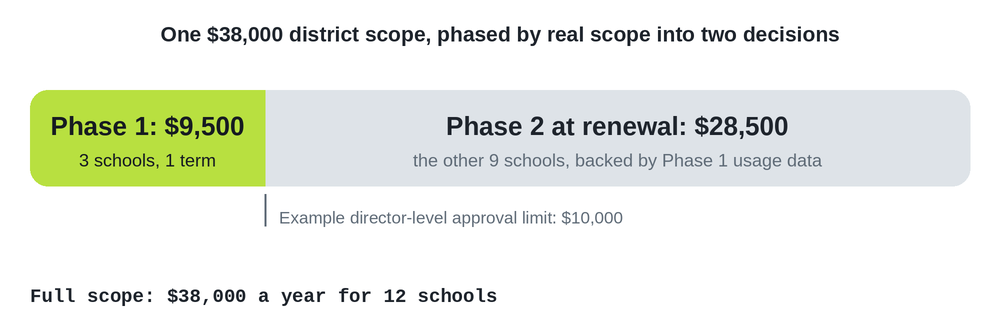
Figure 2. An example: a $38,000 district scope offered as a real $9,500 first phase and a $28,500 second phase at renewal.
The math: a district license for 12 schools at $38,000 a year. Phase 1 covers three schools for one term at $9,500, which sits under an example director-level approval limit of $10,000 in many districts. Phase 2 covers the remaining nine schools at renewal for $28,500, supported by Phase 1 usage data. The district gets evidence before it commits, and the vendor gets a PO this fiscal year instead of next.
Step 4: Time the ask to the amendment meeting
Board agendas close one to two weeks before the meeting. Ask your sponsor two questions: when is the agenda deadline for the next meeting, and does the item need a one-page summary from the requesting department? Then send a board-ready page that fits: what it is, what it costs, which funds, what the district gets, and the next date. One page, no logo wall, no jargon. If the sponsor can paste it into the packet, you have made their job easy.
| When | Action | Output |
|---|---|---|
| Week 1 of October | Read the last two board packets for 25 districts | List of 25 districts with visible movement |
| Week 2 | Email the owner of the need (director or principal) | 10 to 15 replies or meetings |
| Week 3 | Send the phased quote and the district purchasing-policy check | Quote under the approval level |
| Week 4 | Ask for the agenda deadline; send the one-page board summary | Item on the November or December agenda |
| December to February | Support the approval, send the PO details | Purchase order inside the current fiscal year |
For districts on a different fiscal year, shift the same sequence by the district’s own calendar: the amendment window opens roughly four months after the fiscal year starts and runs about three more.
Three emails, one per step
To a curriculum director, sent in week 2:
Subject: Option that fits your current-year budget
Hi Ms. Rivera, I read the October board packet and saw the grant acceptance for K-5 literacy. If part of it is unassigned, I can send a one-page option for a three-school start at $9,500 that runs on current-year funds, with the full 12-school plan at $38,000 available at renewal. I can send it today if you want to look.
To a business official, sent in week 3:
Subject: Purchasing-policy check for a phased agreement
Hi Mr. Okafor, before our team sends a quote to the literacy office, I want to confirm that a phased agreement ($9,500 now, $28,500 at renewal, both in writing) fits your purchasing policy. I can send the full scope and both prices so you can review it before anything is requested.
To a principal, sent in week 2 (site-level option):
Subject: A three-classroom start for this school year
Hi Mr. Chen, if your site has discretionary funds left for this year, a one-grade-band start of our tutoring tool is $3,000 and takes about two weeks to set up. I can send a one-page overview and a short teacher guide for your leadership team.
Where K12 Prospects fits
The amendment sequence depends on reaching the right person fast. K12 Prospects provides verified, role- and district-segmented contacts, so the director, business official, or principal you email in week 2 is the one currently holding the title. The signals themselves, meaning grant acceptances, transfers, and carryover assignments, you spot in board packets and local news. K12 Prospects is how you act on them quickly, across 25 districts at a time.
Do this week
- Pick 25 districts and read their last two board packets.
- Sort into movement and no-movement piles.
- Email the need owner at each moving district with a number and a scope.
- Read each district’s purchasing policy and confirm the phased approach is allowed.
- Ask for the agenda deadline and send the one-page board summary.
The original budget closes in June. The amendment window opens in November. The vendors who show up in October are the ones the director already knows when the agenda item appears.