
The Re-Engagement Sequence for Cold K-12 Contacts Before You Delete Them
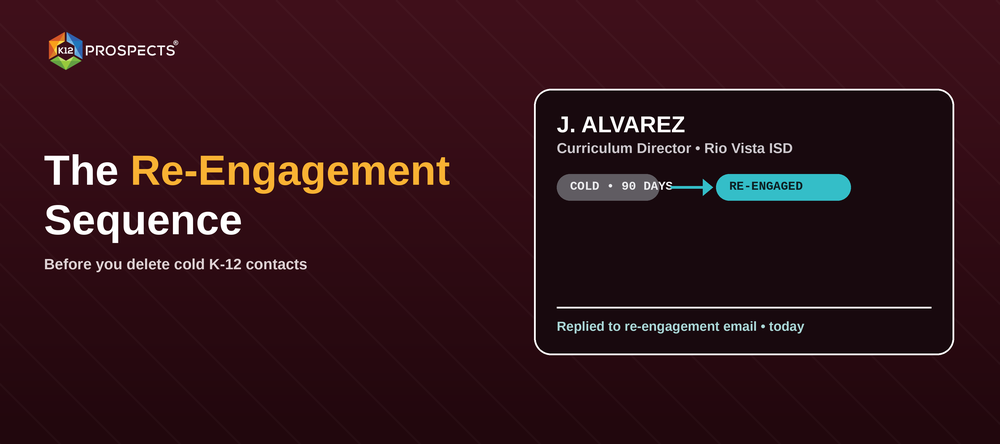
Before deleting 600 unresponsive contacts, one EdTech vendor tried one more thing first: a single re-engagement email, no pitch attached. Forty of those contacts wrote back. Some had simply missed the original outreach during the first weeks of the school year. A few had moved to a different building. One had switched from a curriculum role into an assistant principal seat and was, for the first time, actually the right person to be talking to. None of that would have been visible from a spreadsheet marked “unresponsive.”
Sales and marketing teams tend to treat a cold contact and a dead contact as the same thing, and they aren’t. A cold contact is someone who hasn’t engaged with your last several sends. A dead contact is someone who never will, no matter what you send them. The problem is that from the outside, both look identical: zero opens, zero clicks, zero replies. The only real way to tell them apart is to ask, and most vendors skip that step and go straight to deleting.
Why cold doesn’t always mean dead
A handful of ordinary, boring reasons account for most of what gets labeled “unresponsive” in a K-12 list:
- A K-12 inbox is seasonal. An email that lands during the back-to-school ramp-up in August and September, or during spring testing season, can get buried without ever being deliberately ignored.
- Building or role changes are common enough that “wrong desk” is one of the top reasons an email goes unanswered even when the address itself still works.
- A message can land somewhere it’s rarely checked — a promotions tab, a shared department inbox nobody’s assigned to that week, or a spam-adjacent folder after a district gateway quietly lowers a sender’s reputation score.
- Plenty of educators are simply slow to reply to vendor email as a category, not because they’re uninterested, but because it’s never urgent enough to rise above lesson planning and parent email.
None of those explanations show up in an email platform’s engagement dashboard. A 90-day-cold tag looks the same whether the contact quietly left the district in June or just hasn’t had a slow week since September.
The cost of deleting without asking
A list purge feels tidy. Sender reputation improves, the dashboard looks cleaner, and it takes one bulk action to finish. But every contact removed without being asked first is a contact that had to be found, matched to a role, and verified in the first place — work that gets thrown away and eventually has to be redone if that person turns out to matter later.
The asking step is cheap by comparison. One email and roughly ten minutes of setup either recovers a real contact or produces a clean, deliverability-safe reason to remove them — an actual opt-down instead of a guess. That distinction matters for the rest of the list too, not just the contacts being reconsidered: unengaged addresses that are never resolved either way keep dragging down the sender reputation that determines whether everyone else’s email reaches the inbox at all. This is the same discipline behind List Hygiene: How Cleaning and Updating Data Improves Your Open Rate — a list that’s actively maintained outperforms one that’s just left to decay quietly in the background.
The three-email re-engagement sequence
The sequence is short on purpose: three emails, spaced roughly a week to ten days apart, each with one specific job. It isn’t designed to sell anything — it’s designed to get a real answer, one way or the other.
Email one isn’t a check-in. It’s something worth opening on its own.
Skip the “just following up” opener entirely. The first email should deliver something genuinely useful with zero ask attached — the single most useful resource from the original sequence, an updated stat relevant to their role, or a short, specific observation tied to the season (a testing-window tip, a budget-calendar note). No mention of the lack of response. No pressure. If this is the only email in the sequence that gets opened, it should still have been worth their time.
Sample subject: “One thing that might actually help this month” — body leads with the resource itself, no reference to prior silence.
Email two asks the actual question, plainly.
Replace the vague “just following up” with a direct, binary question framed around them rather than the vendor: is this still something on their radar for the current semester, or would it make more sense to check back later in the year. A one-click reply option (“still relevant” / “not right now”) lowers the effort required to answer to almost nothing, which is often the entire reason a contact hasn’t replied to anything else.
Sample subject: “Still on your radar for this semester?” — body offers a two-option reply instead of an open-ended ask.
Email three tells them exactly what happens next.
This is the email that protects deliverability, not just the relationship. State plainly that they’ll be moved off active sends unless they’d rather stay, and leave the door open for later. A graceful, stated opt-down produces far fewer spam complaints than either an abrupt disappearance or continuing to blind-send to an address that’s already shown three rounds of disinterest — and it gives the vendor a clean, honest reason to remove the contact when there’s still no response.
Sample subject: “Last note — I’ll stop here unless you’d like to stay on the list” — body is short, warm, and specific about what happens if there’s no reply.
What to do with each outcome
- Replied or clicked through: reroute the contact back into the applicable active sequence, treating the reply as a fresh first touch rather than a continuation of the old one. This is exactly the kind of re-warmed contact The 5-Email Sequence That Turns K-12 Lookers Into Buyers is built to move forward.
- Opened but didn’t reply: move to a slower cadence — quarterly rather than biweekly — instead of either full active sending or outright removal. Some contacts are genuinely interested but simply operating on a longer timeline than the original sequence assumed.
- No engagement across all three: remove from active sending. This isn’t necessarily permanent — a contact who’s genuinely gone quiet today can resurface as the right person again after a role change, and fresh, verified data is what makes that person findable a second time instead of starting the search over from nothing.
When to run this
The sequence works best paired with a checkpoint that already exists on the calendar rather than as a standalone project: right before a scheduled list purge, ahead of a new semester’s campaign push, or alongside an annual data refresh. Running it in isolation, disconnected from any actual cleanup decision, just adds three more emails to send without changing what happens to the list afterward.
Forty contacts out of six hundred isn’t a dramatic recovery rate on paper. In practice, it was forty relationships that would have been deleted on the strength of an assumption, recovered by asking one honest question first. The other 560 weren’t a loss either — they left the list with a clean, deliverability-safe answer instead of a guess. Cold isn’t a verdict on a K-12 contact. It’s usually just a question nobody asked yet.