The Cold-to-Client Ladder: A K-12 Blueprint for Turning Cold Contacts Into Subscribers, Then Leads
How one EdTech company worked a 10,000-contact cold district list up a ladder — stranger to reader to subscriber to lead — and what exactly was done at every stage.
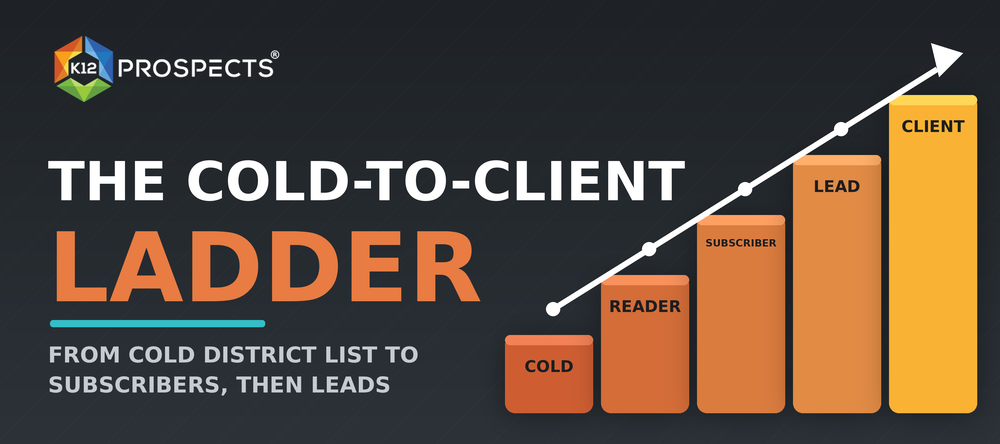
Last school year, a company selling a formative-assessment platform to elementary and middle schools ran a campaign we think every K-12 marketing and sales team should study. They started in September with 10,000 cold contacts — principals and curriculum directors — and instead of blasting the list with a pitch, they worked it up a ladder: stranger, reader, subscriber, engaged subscriber, lead. By spring the same list had produced 340 subscribers, 58 demos, and a pipeline that keeps refilling itself. This is the blueprint, stage by stage, exactly as they ran it.
The principle underneath everything they did fits in one sentence: every email sells the next rung, never the top. A demo is a rung-five ask, and a cold contact is standing on the ground floor — so the campaign never asked a stranger for a meeting. From a stranger it asked for a read. From a reader, a click. From a clicker, an opt-in. From a subscriber, attention. Only an engaged subscriber ever heard about a demo. Each ask was small enough to say yes to on a phone between meetings, and each yes handed the team permission — and data — for the next one.
Stage 1 — What they set up before sending: two systems
The first two weeks produced no emails at all. The team split their infrastructure in two, because mailbox providers and district security gateways score reputation by domain, and cold mail takes damage that opted-in mail should never inherit. Cold sequences went on a dedicated subdomain (outreach.<company>.com) with its own SPF, DKIM, and DMARC records, warmed from about fifty sends a day, on a platform that stops a sequence the moment anyone replies. Subscribers would live somewhere else entirely: the company’s regular ESP on the main marketing domain — with a hard rule that nobody enters it without an explicit opt-in. One line per contact in the CRM recorded a single thing: which rung, and what moved them there.
That separation paid for itself twice over the year. A cold send that tripped one state’s district filter cost them a week of deliverability on the outreach subdomain — and nothing anywhere else. And because the ESP held only people who had chosen to be there, its engagement rates stayed high, which is precisely what keeps a subscriber domain landing in inboxes.
Stage 2 — The list they started from
They spent no time scraping directories, because the bottom rung can’t be guesswork. The list was role-segmented and verified — principals and curriculum directors, tagged by district and enrollment — sourced from K12 Prospects and current against the summer churn, which is why September’s first sends bounced under two percent. That number matters more than any subject line: roughly one in six principals changes jobs each year, district IT deactivates mailboxes within weeks, and a subdomain that is still warming cannot absorb a nine percent bounce rate. The list hygiene discipline stayed on through the year — bounces suppressed weekly, role changes rechecked before each big send.
Just as important, the two roles never received the same email. Principals got building-level language — schedules, staff time, family nights. Curriculum directors got standards coverage and data. Same product, two conversations, because in a district those are different purchases.
Stage 3 — The five cold emails they sent
The cold sequence ran five emails over three weeks — days 1, 4, 9, 15, and 21 — each carrying one idea, one link, no attachments, and a subject line whose first thirty-five characters survive a phone screen. The pacing follows the 5-email sequence logic: value first, one job per send, a close that costs nothing to accept. Here is what each email did:
- Email 1 established that the sender was worth reading: one genuinely useful insight about assessment time crowding out instruction time, written for the role. No product, no ask.
- Email 2 made the problem concrete with a short example — what hand-built benchmark testing costs a school in teacher hours per term.
- Email 3 offered the bridge: a free grade-banded benchmark pack teachers could use that week, behind a one-field landing page.
- Email 4 brought proof — anonymized score movement from schools of similar size — and ended on the same link.
- Email 5 closed the loop politely and left the link standing.
Here is the day-1 email, close to verbatim, as it went to principals:
Subject: The 6 hours your teachers spend building tests
“Hi [First name] — nothing to sell in this note. We spend all year around elementary schools, and one number keeps coming up: teachers lose five to six hours per benchmark cycle building and grading their own practice assessments — time that used to be instruction. If that sounds like [School], you’re not alone, and some schools have clawed most of it back without buying anything. I’ll share what we’ve seen work over the next couple of weeks. Either way — thank you for what you and your staff carry every day.”
And the day-9 bridge email, whose only job was the click:
Subject: A free benchmark pack for [School]’s grade bands
“Hi [First name] — as promised, something usable instead of a pitch: a free benchmark pack for grades 3–5. Ready-to-run practice assessments, an answer key, and a one-page item-analysis sheet your teachers can use this week. One click, no forms to fill: Download the pack. If it saves your team an afternoon, it did its job.”
Two rules ran across the whole sequence. Any reply, at any point, pulled the contact out of automation and onto a rep’s desk the same day. And no email ever mentioned a demo — the sequence’s only goal was to earn the click on something worth trading an email address for.
Stage 4 — The bridge: where clicks became subscribers
The landing page was deliberately bare — a headline (“The Grades 3–5 Benchmark Pack”), one line of description (“Ready-to-run practice assessments plus an item-analysis sheet — free”), one field (work email), and one button (“Send me the pack”). No name, no district, no phone number: every extra field costs downloads, and the role and school data already existed on the list. The real conversion came one step later, in the delivery email:
Subject: Your benchmark pack (grades 3–5)
“Here’s your pack: Download link. One more thing, worth exactly one click: we refresh this pack every month with new items and one short note on reading the results. Send me the monthly pack — that’s the whole signup. Unsubscribe anytime, no hard feelings.”
That second click — “Send me the monthly pack” — was the campaign’s hinge. It moved the contact off the cold subdomain and into the ESP as a subscriber: a person who had now said yes twice, on the record. Out of 10,000 contacts, about 520 took the download over the sequence’s three weeks, and 340 clicked the monthly-pack button by the end of the first month.
Three and a half percent of a cold list may not sound like a headline, but compare the asset classes: a cold contact evaporates the day they change jobs or the moment a pitch annoys them. A subscriber is a permission asset — reachable twice a month, legitimately, through this year’s budget freeze and into next year’s planning season, generating open-and-click data that tells sales exactly who is warming up.
Stage 5 — How they nurtured: the school calendar did the scheduling
Subscribers got something useful twice a month, never more — a fresh benchmark set, a data-reading template, a short piece on testing windows — three value sends for every soft offer. The timing came straight from the district rhythm: steady through the January-to-May planning season when next year’s budgets take shape, a deliberate push in the overlooked summer window when leaders finally have desk time, and silence during August opening weeks. Engagement was scored simply: three opens or one click across the last six sends marked a subscriber as engaged — rung four. By January that flag sat on about 110 people.
Stage 6 — The handoff: when sales finally entered
A subscriber became a lead on behavior, not on time served: clicking pricing, downloading a second gated asset, registering for the webinar, or replying. Those signals — and only those — moved a contact to a rep, and the rep’s rule was speed: a personal answer the same hour where possible, two spaced nudges after that, and then, crucially, no dead end. A contact who went quiet slid back to rung three and kept receiving the newsletter, still warm for the next budget cycle. A curriculum director who had ignored two nudges in November replied to a February benchmark send:
“We’re planning next year’s assessment budget this month — is that walkthrough still available?”
The rep’s answer shows what a rung-five email looks like — a real answer plus two specific times, never a bare calendar link:
“Glad the packs are earning their keep, [First name]. Happy to walk you through the full item bank and how schools your size run winter benchmarks with it — 15 minutes covers it. I have Tuesday at 1:00 or Wednesday at 9:30 ET; either work? If the timing’s wrong, the monthly pack keeps coming regardless.”
That exchange is the ladder working as designed: nothing about the contact was lost when the first conversation stalled, and even the demo offer protects the subscription underneath it.
The spring tally on the original 10,000: 340 subscribers, 110 engaged, 58 demo conversations, and a subscriber list that starts next fall’s campaign on rung three instead of rung zero. The pitch-blast alternative converts a cold list once, then burns it. The ladder converts it slowly, then keeps it.
Running the same blueprint
The order matters more than any single tactic: split cold infrastructure from the subscriber system and warm the cold subdomain; start from an accurate, role-segmented list; run five one-idea emails in three weeks with a gated asset as the only destination; convert downloads into explicit subscribers; nurture twice monthly on the school calendar; and let sales touch only the contacts whose behavior asked for it. Every stage compounds whatever the bottom rung gets wrong, which is why the list is the one place not to improvise. K12 Prospects keeps role-segmented, verified district contacts current against the summer churn, so the ladder you build sits on live inboxes the way this one did. Build it once, and the list you already own becomes the pipeline you were about to pay for again.